Introduction: What Is a Stanza in Poetry
If you have ever looked at a poem and noticed that the lines are grouped into little blocks, separated by a gap, you were looking at stanzas. Understanding them is one of the quickest ways to read poems with more pleasure and to write better ones yourself.
What is a stanza in poetry?
A stanza is a group of lines in a poem, set apart from other groups by a blank line. It works like a paragraph in prose: it holds one idea, one image, or one step of the feeling before the poem moves on.
The word comes from Italian, where stanza means “room.” That is a helpful way to picture it. A poem is a house, and each stanza is a small room with its own mood.
Stanza or verse: what is the difference?
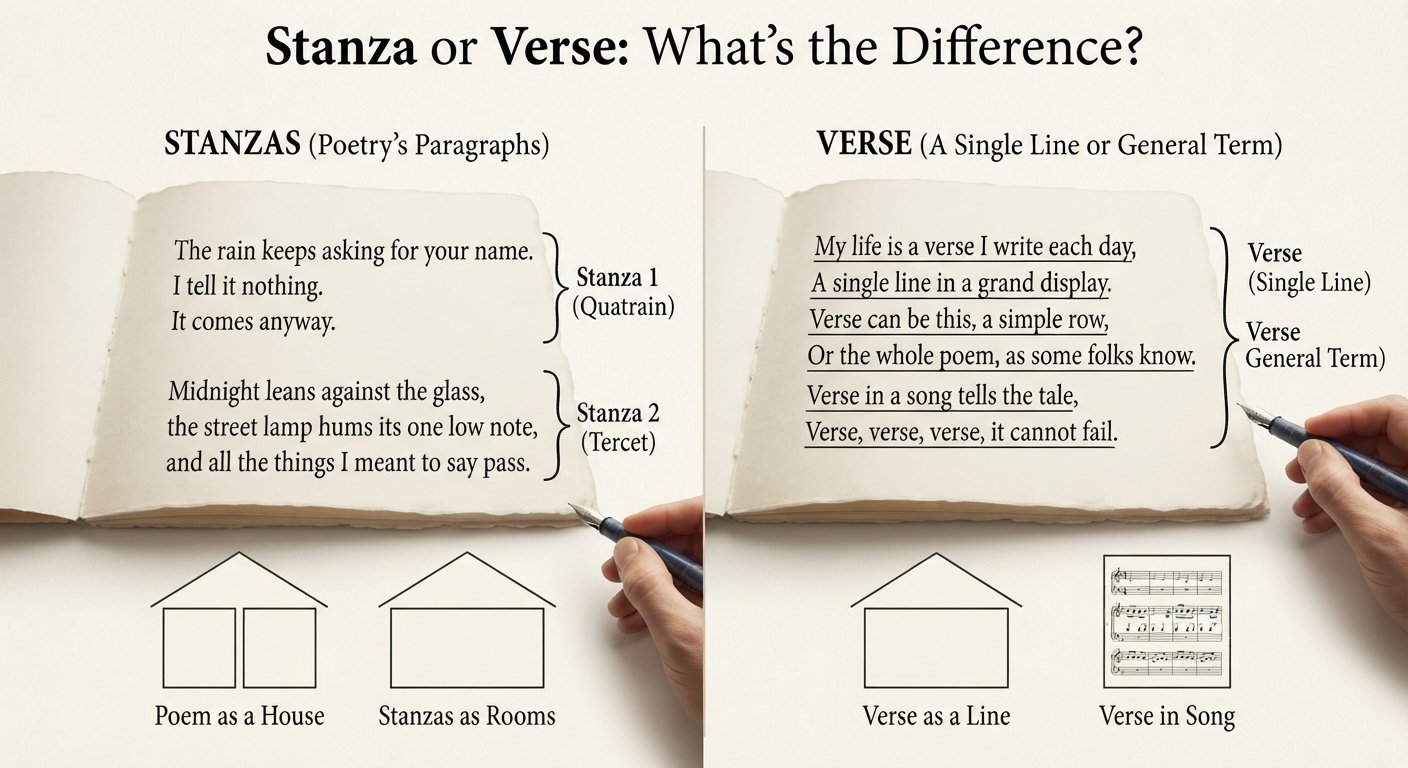
People often use the two words as if they mean the same thing, but they do not always. Verse can mean a single line of poetry, a stanza, or poetry in general. In songs, a verse is the part that tells the story and changes from section to section, while the chorus repeats. In poetry, stanza is the clearer word for a group of lines.
Types of stanzas by number of lines
Stanzas have names based on how many lines they hold:
- Couplet: 2 lines
- Tercet: 3 lines
- Quatrain: 4 lines
- Cinquain: 5 lines
- Sestet: 6 lines
- Septet: 7 lines
- Octave: 8 lines
The most common ones in English poetry are the couplet, the tercet, and the quatrain. Here is each one in an original example.
Couplet (2 lines)
A couplet is a pair of lines, often rhymed, but not always. It feels quick and complete, like a short sentence you can hold.
The rain keeps asking for your name.
I tell it nothing. It comes anyway.
Tercet (3 lines)
A tercet gives you room for a small image and a turn. It is light and a little open at the end.
Midnight leans against the glass,
the street lamp hums its one low note,
and all the things I meant to say pass.
Quatrain (4 lines)
The quatrain is the most popular stanza in English. It has a steady, song-like feeling. This one follows an ABAB rhyme scheme, which means the first and third lines rhyme, and the second and fourth lines rhyme.
I keep your coat beside the door,
the way you left it, sleeves askew.
It holds the shape of you, and more
than I can say to anyone but you.
Longer stanzas
A sestet (6 lines) and an octave (8 lines) give a poem more space to build an idea. They are best known from the sonnet. A Petrarchan sonnet is made of an octave followed by a sestet, and a Shakespearean sonnet uses three quatrains and a final couplet.
Stanzas and rhyme schemes
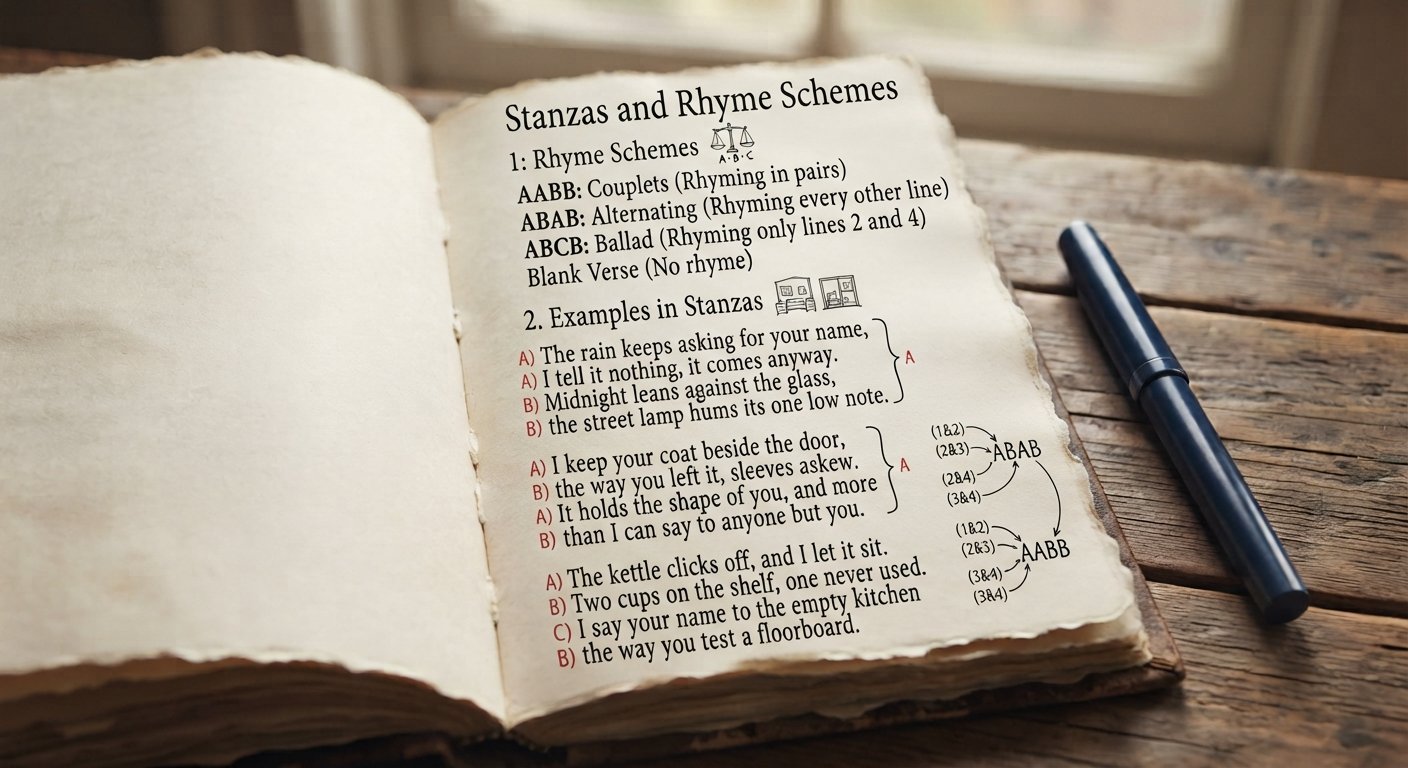
When a stanza rhymes, poets describe the pattern with letters. Each new rhyme sound gets the next letter.
- AABB: the lines rhyme in pairs
- ABAB: the lines rhyme in alternating order
- ABCB: only the second and fourth lines rhyme, which is common in ballads
Rhyme is never required. Many modern poems use stanzas with no rhyme at all, relying on images and pauses instead.
How stanza breaks work
A stanza break is the blank space between stanzas. It is a pause, and poets use it on purpose:
- To change the image or the thought. The new stanza starts a new scene.
- To slow the reader down. The white space gives a feeling time to land.
- To create surprise. A short stanza after a long one can hit hard.
- To keep the poem easy to read. Groups of lines are easier on the eye than one long block.
Stanza breaks are different from line breaks. A line break is a tiny pause inside the stanza, and a stanza break is a larger one.
Stanzas in well-known poem forms
Some forms are defined partly by their stanzas:
- Sonnet: 14 lines, arranged in stanzas such as an octave and sestet, or three quatrains and a couplet.
- Villanelle: 19 lines made of five tercets and one quatrain.
- Haiku: usually a single tercet-style poem of three short lines.
- Free verse: stanzas of any length, chosen by feel.
How to write your own stanzas
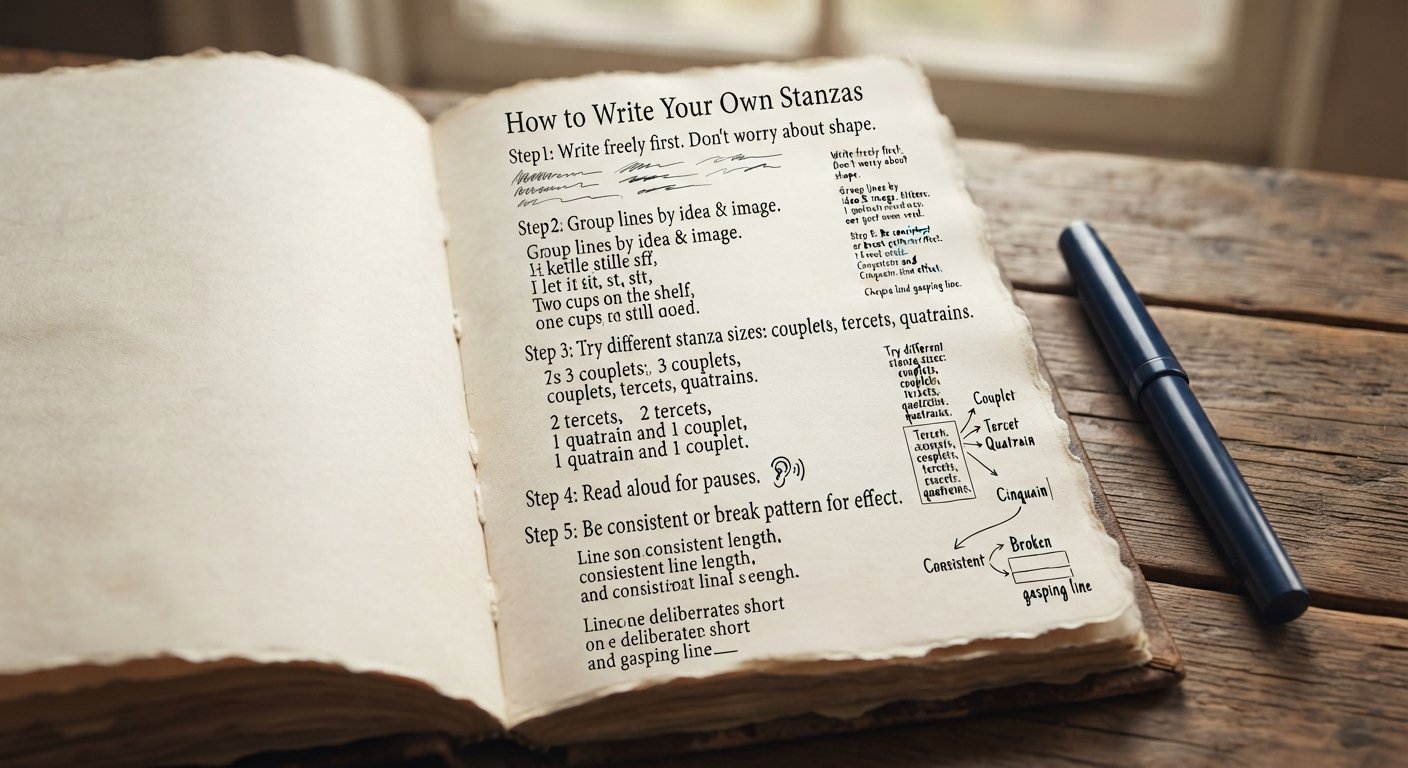
- Write your lines first. Do not worry about the shape yet. Write the poem in a rush.
- Group lines by idea. Whenever the image or feeling changes, that is a natural place for a break.
- Try different sizes. Rewrite the poem in couplets, then in tercets, then in quatrains. Notice how the feeling changes. Couplets feel quick, tercets feel open, and quatrains feel steady.
- Read it aloud. Your voice will tell you where the pauses belong.
- Be consistent, or break the pattern on purpose. Equal stanzas feel calm. One short stanza near the end can feel like a gasp.
If you are new to writing, our guide on how to write poetry walks you through a poem from the first feeling to the final edit.
Read stanzas in real poems
The best way to learn stanzas is to see them at work. Browse our poems and look at how each poem groups its lines. Try Lost Love and Heartbreak or Nostalgia, and notice where each poem takes a breath. When you write one of your own, you can send it to our Submit Your Poetry page.
FAQ
How many lines are in a stanza?
There is no fixed number. Most stanzas have between 2 and 8 lines, but a stanza can be a single line or much longer.
Do stanzas have to rhyme?
No. A stanza is defined by the grouping of lines, not by rhyme. Many stanzas are unrhymed.
Is a stanza the same as a paragraph?
They are similar. A paragraph groups sentences around one idea in prose, and a stanza groups lines around one idea in poetry.
What is the difference between a stanza and a line?
A line is a single row of words in a poem. A stanza is a group of lines.
A stanza is a small room, and a poem is the house you build from many of them. Once you can see the rooms, every poem becomes easier to read and easier to write.